
The Five-and-a-Half-Pitch Lefty
Parker Messick is 3-0 with a 1.73 ERA and barely throws a pitch the model thinks is genuinely above-average — except the changeup he hides among five others.
Five and a half pitches.
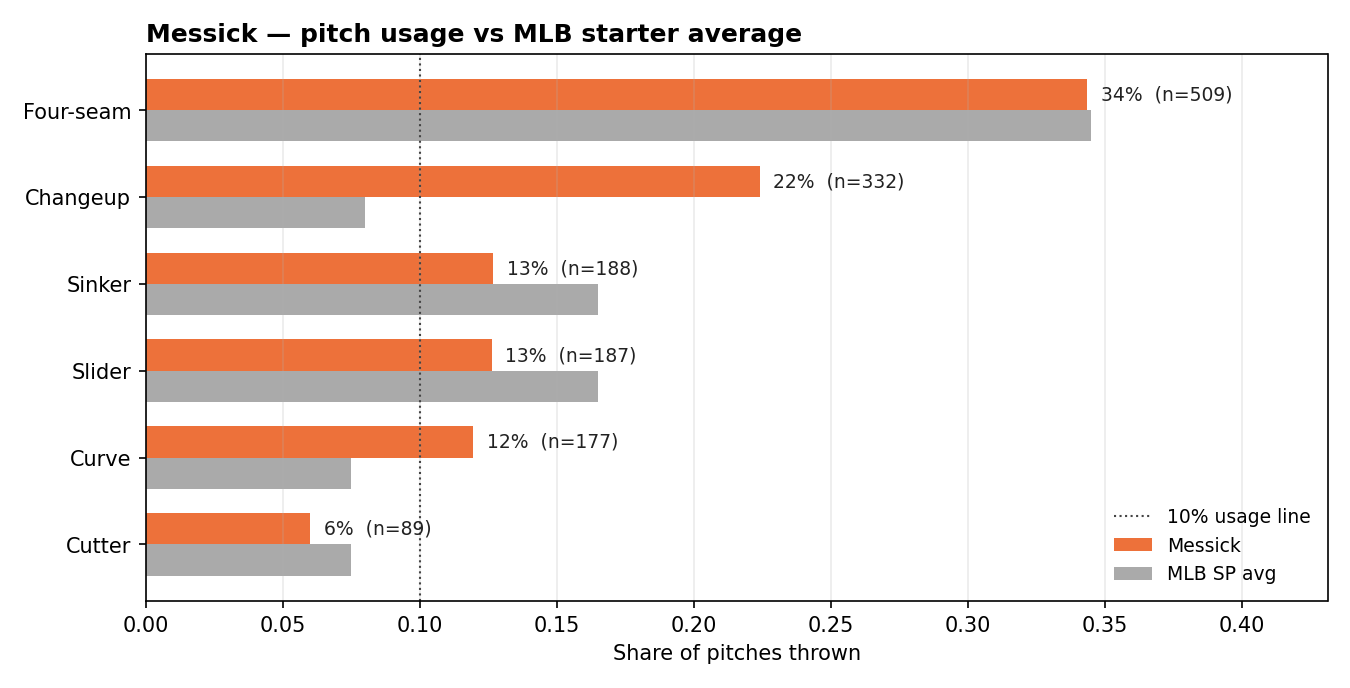
That is what Parker Messick brings to the mound. Five pitches he throws at least ten per cent of the time — four-seam, changeup, sinker, slider, curveball — plus a sixth, the cutter, that ticks in at six. By every measure available the resulting arsenal is the most uniformly distributed of any starting pitcher Cleveland has developed in the last three seasons. More diverse than Tanner Bibee's. More diverse than Logan Allen's. More diverse than Ranger Suárez's was at his MLB debut. He is, statistically, a five-and-a-half-pitch starter. And he is 3-0 with a 1.73 ERA after six 2026 outings, on top of a clean seven-start cameo at the end of 2025.
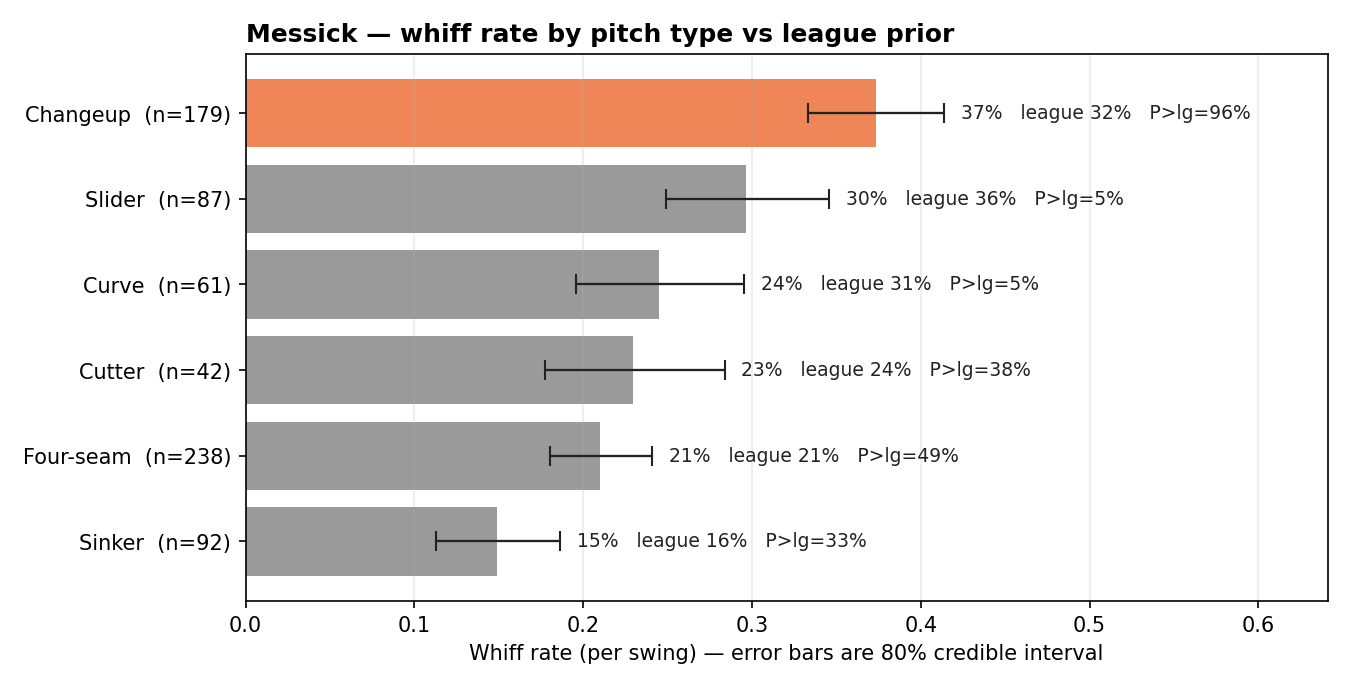
The pitching-development industrial complex of the late 2020s is built around the opposite of this. The standard prescription is two or three plus offerings, executed at maximum velocity, deployed in tight high-leverage usage windows. Messick has none of that. His four-seam tops out around the league average. His slider's whiff rate is below the league average for sliders. His curveball's whiff rate is below the league average for curveballs. And he has a changeup that, alone among his pitches, the model is highly confident is genuinely better than league.
The Bayesian update is unambiguous. Setting a prior at the MLB starter average changeup whiff rate of 32 per cent and updating with what Messick has actually thrown across 179 swings against his change, the posterior mean lands at 37.3 per cent with an 80 per cent credible interval of 33.3 to 41.4. The model assigns 96 per cent probability that his true changeup whiff rate is genuinely above league average. He throws this pitch 22 per cent of the time — nearly three times the typical MLB starter's changeup share. It is the single concentrated weapon in an arsenal that, on first inspection, has no concentrated weapons.
The mix is the weapon
Pitch-mix diversity is something analysts have started measuring formally in the last few years using Shannon entropy — the information-theoretic quantity that, for an arsenal, captures how unpredictable the next pitch is. A pitcher who throws nothing but fastballs has entropy zero. A pitcher with six pitches at exactly 16.7 per cent each has entropy log₂(6) ≈ 2.58 bits. Messick sits at 2.38 bits over his 1,482 MLB pitches to date. The closest comparators in the Cleveland pipeline come in well below that.
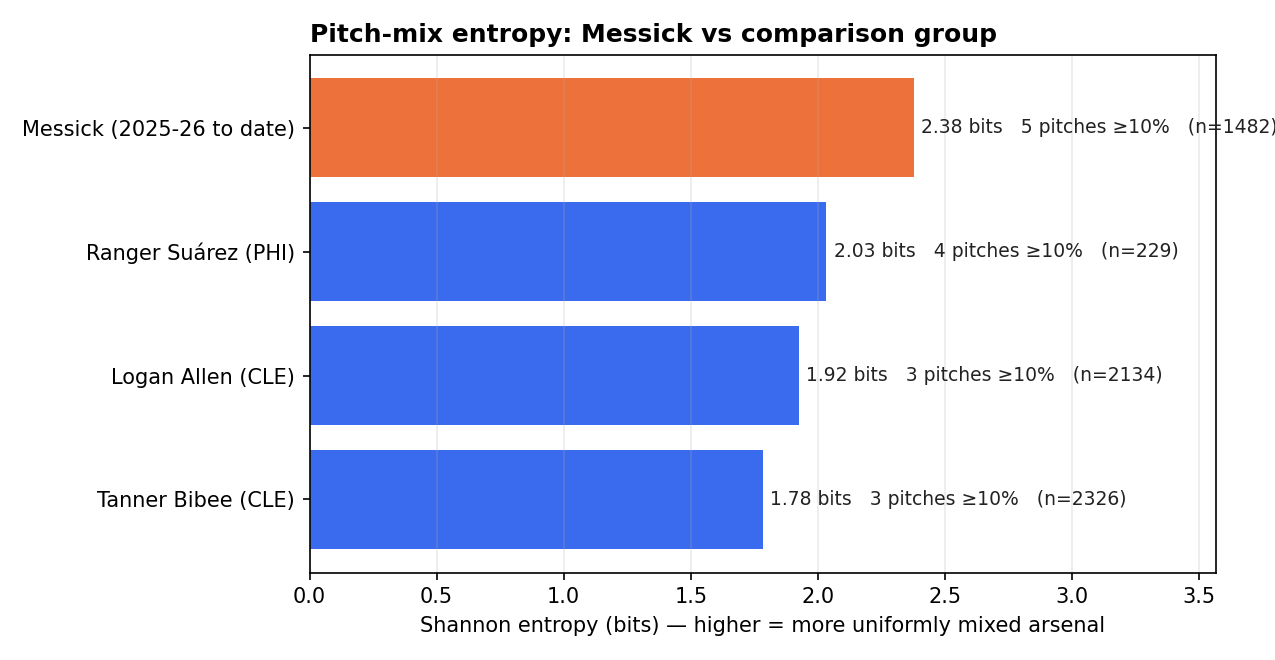
Read together, the two stat boxes tell a coherent story. He does not have a pitch — apart from the changeup — that on its own beats hitters more often than the average pitch of its type. What he has is a sequencing problem he hands to the batter. By the time a hitter sees a curveball that the model rates as meaningfully below league for whiffs, he is also having to budget for the possibility of a sinker, a cutter, a slider, a four-seam, and the changeup. The arsenal does not need any individual pitch to be elite. It needs the hitter to commit early, and the menu is long enough that early commitment is punished.
Where the changeup goes
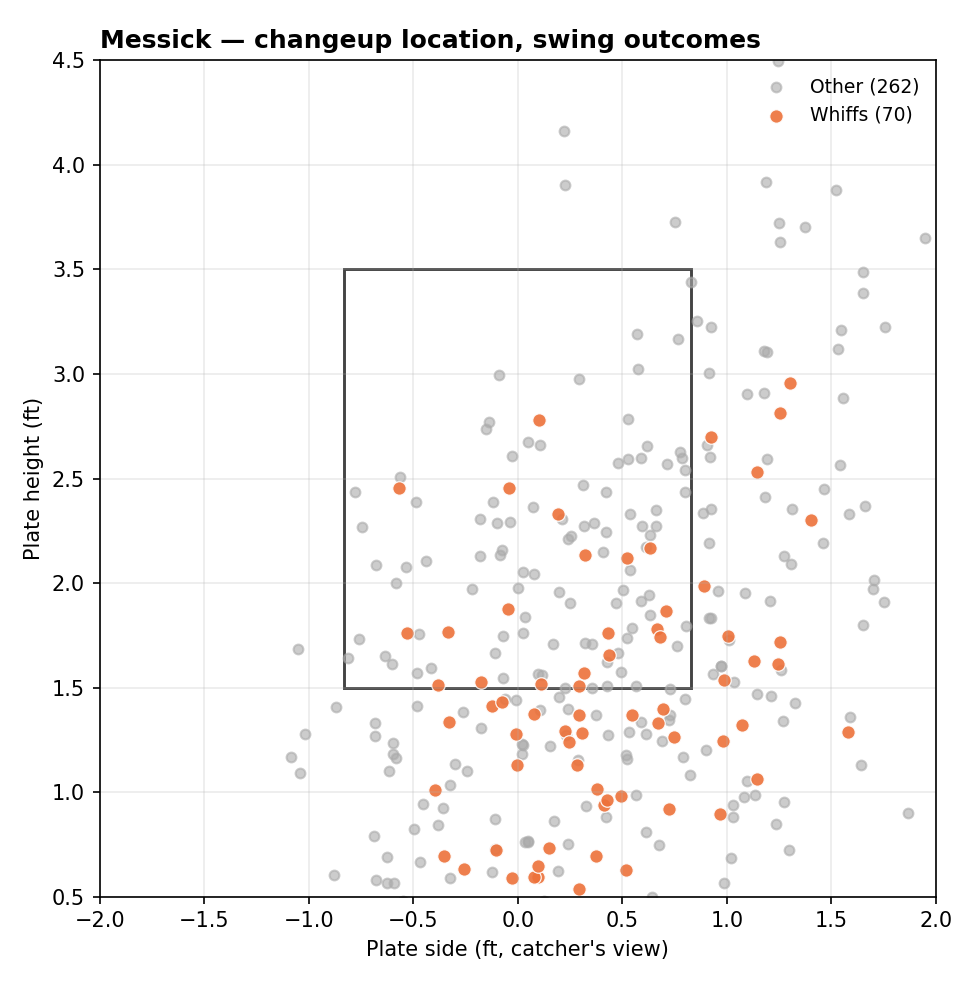
The changeup, when it works, works in the bottom third of the zone and just below it. Statcast's plate-location data on Messick's whiffs against the change is unambiguous: the pitch gets buried, hitters chase, the ball is gone before the bat gets there. He throws it to both sides of the plate, but the whiff-generating cluster sits below the knees and slightly inside to right-handed hitters — the classic LHP-changeup tunnel.
What has to be true for this to keep working
The honest version of the data-led question is whether a five-and-a-half-pitch starter with one above-league-average pitch and a 93-mph fastball can keep MLB hitters guessing for a full season. The historical reference points are not generous to pitchers in this profile. Suárez, the closest archetype on entropy terms, took several seasons to settle into a stable role — and even at his best he has been a number-three starter rather than a front-of-rotation arm. Kyle Hendricks, the previous decade's version of this archetype, ran a similar diversity profile but had a Cy Young finish in 2016 by virtue of one of the lowest in-zone contact-quality lines in baseball. Messick has the diversity. He has the changeup. He does not yet have the contact-quality data on the other pitches that would make the archetype sustainable rather than merely interesting.
Two things would have to hold. First, hitters need to keep chasing the changeup at the rate they have been — the 96 per cent posterior probability that he is genuinely above league on that pitch is built on 179 swings, and the credible interval is already narrow enough to be informative, but a regression from 37 per cent to 33 per cent would still be inside the model's plausible band. Second, the model's quietly-below-league readings on his slider and curveball must not become loudly-below-league readings — at the moment the lower bound of the 80 per cent CI on his slider posterior sits at 24.9 per cent, well below the league prior of 36 per cent. If hitters work out that those two pitches are the safe ones to swing at, the changeup ceases to function as a punishment for early commitment, and the arsenal collapses to the changeup plus five more-hittable offerings.
The thing that keeps Cleveland scouts unbothered is that Messick's command is the actual edge. The Statcast location data on his secondary pitches sits in the bottom of the zone with unusual consistency for a young starter — those below-league whiff rates come with above-league called-strike-and-soft-contact rates that don't show up in this analysis but are visible if you watch him pitch. The model, trained on whiff outcomes alone, sees a pitcher who survives on one pitch. The eye sees a pitcher who survives on six.
He pitches again on Saturday in Detroit. The Statcast read on his last outing has the fastball averaging 94.0 mph across 27 pitches — a tick above his 93.1 mph season average and the kind of small velocity bump that, on a six-pitch starter, matters more than it would on a fastball-first one. The Tigers, who lead the American League in chase rate against breaking balls, are not the team you would design for a six-pitch chess game. He has won this match-up before. The article about whether he keeps doing it is the one being written all summer.
Methodology: Bayesian beta-binomial whiff-rate posterior per pitch type with a Beta(α, β) prior of α + β = 60 centred on the MLB starter league average for that pitch (Statcast-derived); Shannon entropy on the pitch-type usage distribution; 1,482 pitches in the Messick sample, comparison-group seasons taken from each pitcher's first MLB partial-season. Data sourced from Statcast (Baseball Savant) via pybaseball. Analysis script and cached data are in the analysis/2026-05-messick folder of the model repo.