
The Murakami Paradox
The breaking-ball weakness scouts spent five years documenting has followed him to Chicago. He is leading the American League in slugging anyway. The question for the next two months is how long the contradiction holds.
Fifty-two point eight per cent.
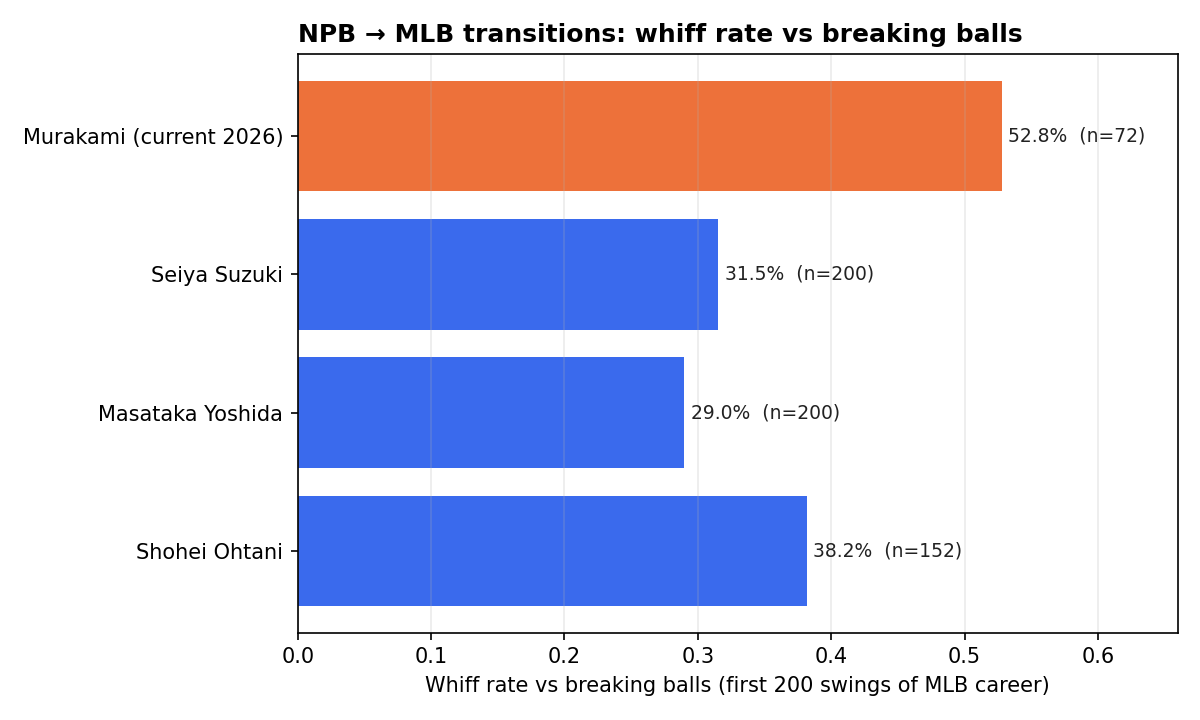
That is the rate at which Munetaka Murakami has missed when he has swung at an MLB breaking ball. Of his seventy-two attempts at sliders, sweepers and curveballs since debuting on 26 March, thirty-eight have been swings through air. It is the worst breaking-ball whiff rate of any Japanese position-player transition we have on record — worse than Seiya Suzuki's first 200 swings (31.5 per cent), worse than Masataka Yoshida's (29.0), worse even than Shohei Ohtani's (38.2), who was twenty-three years old, fresh off a back injury, and still finding his stance. Murakami is two years older than Ohtani was, has a Triple Crown to his name in NPB, and has been the most-scouted bat to leave Japan since Hideki Matsui. The concern that followed him across the Pacific was not subtle. He cannot lay off the slider.
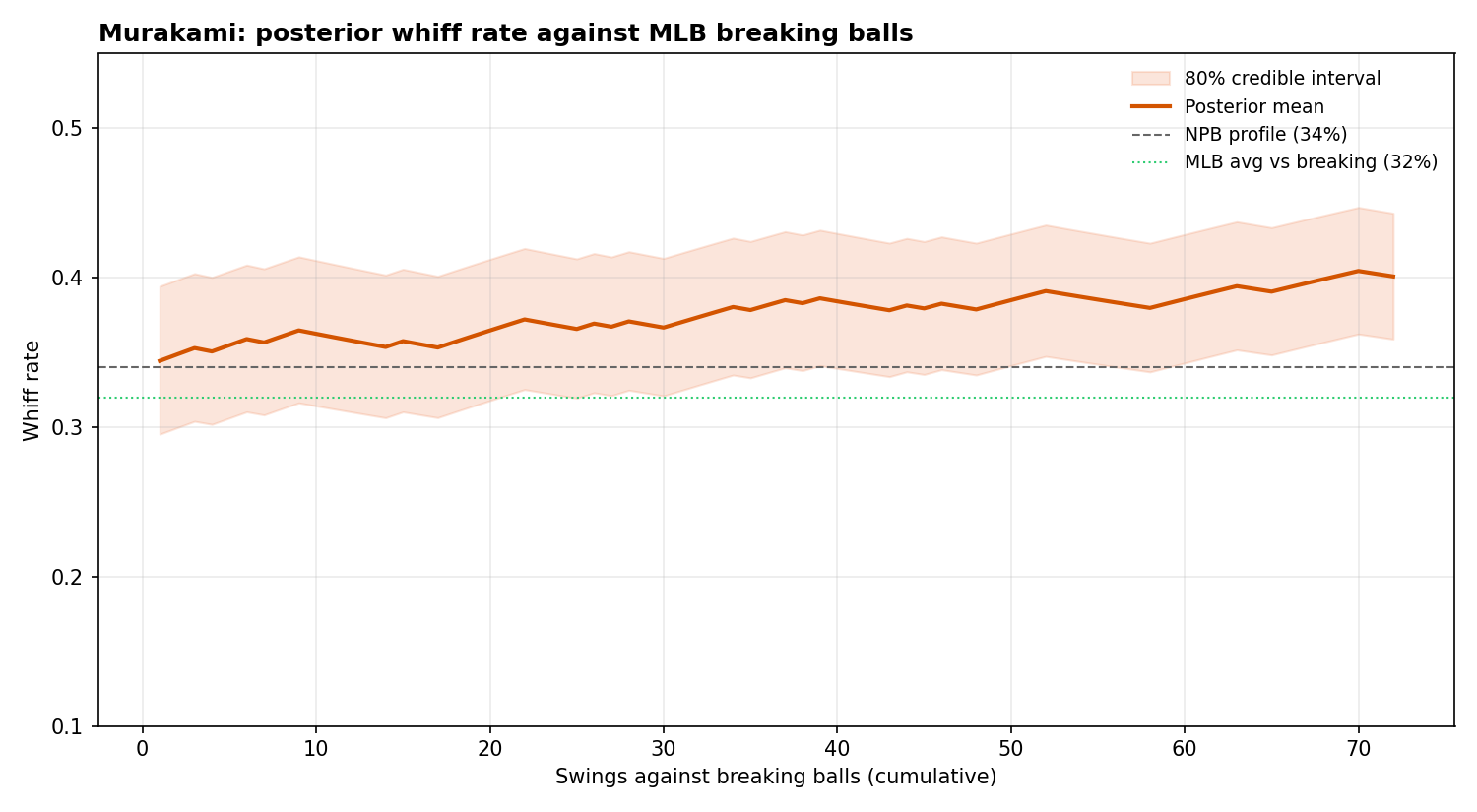
The Bayesian update is unambiguous. Setting a prior at his NPB scouting estimate of roughly 34 per cent and updating with what he has actually done in seventy-two MLB swings, the posterior mean lands at 40.1 per cent with an 80 per cent credible interval of 35.9 to 44.3. The model assigns 3 per cent probability that his true rate is below the NPB mark and 1 per cent probability that it is at or below the MLB league average of 32 per cent. He is, by the strictest available reading, performing meaningfully worse against breaking balls in MLB than the scouting reports said he would.
And he is leading the American League in slugging.
When he connects
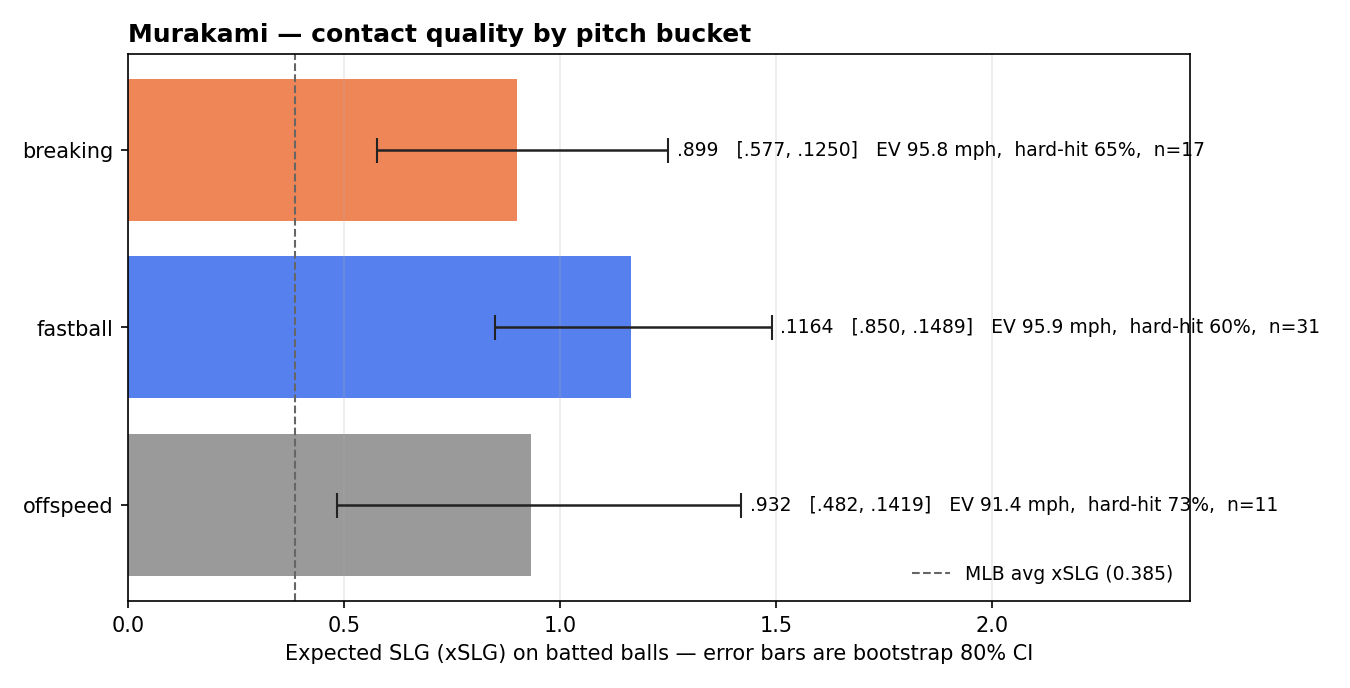
The contradiction sits one column over on the Statcast page. When Murakami does make contact — fastball, breaking ball, change-up, the pitch type genuinely does not matter — what happens next is consistently spectacular. His expected slugging on fastballs is 1.164. The bootstrap 80 per cent confidence interval, which corrects for the modest sample of thirty-one batted balls, ranges from .850 to 1.489. Even at the bottom of that interval he is producing 2.2 times the MLB league average xSLG of .385. His breaking-ball xSLG, on a smaller seventeen-ball sample, is .899 with an interval of .577 to 1.250 — meaning even when he connects with a slider, the model expects a double or better. His average exit velocity on every pitch type sits between 91 and 96 mph. He hard-hits two thirds of every ball he puts in play.
This is what the analytical community calls a feast-or-famine profile, and Murakami is currently dialled to its extreme setting. He is whiffing constantly. He is slugging constantly. The two are simultaneously true because, for the moment, MLB pitchers have not adjusted their diet. He has seen 104 fastballs to 72 breaking balls in the season's first month. That ratio is not going to hold.
The pattern shift waiting to happen
The structural question, then, is what happens when MLB pitchers watch the tape. They will. They already are. A hitter who whiffs at 53 per cent of breaking balls and faces them on 40 per cent of pitches is a different player from one who faces them on 60. The first is a strikeout machine in a hitting slump waiting to start. The second is leading the American League in slugging. Murakami has spent the last month being the second player. The next month is when we learn whether he can stop being the first.
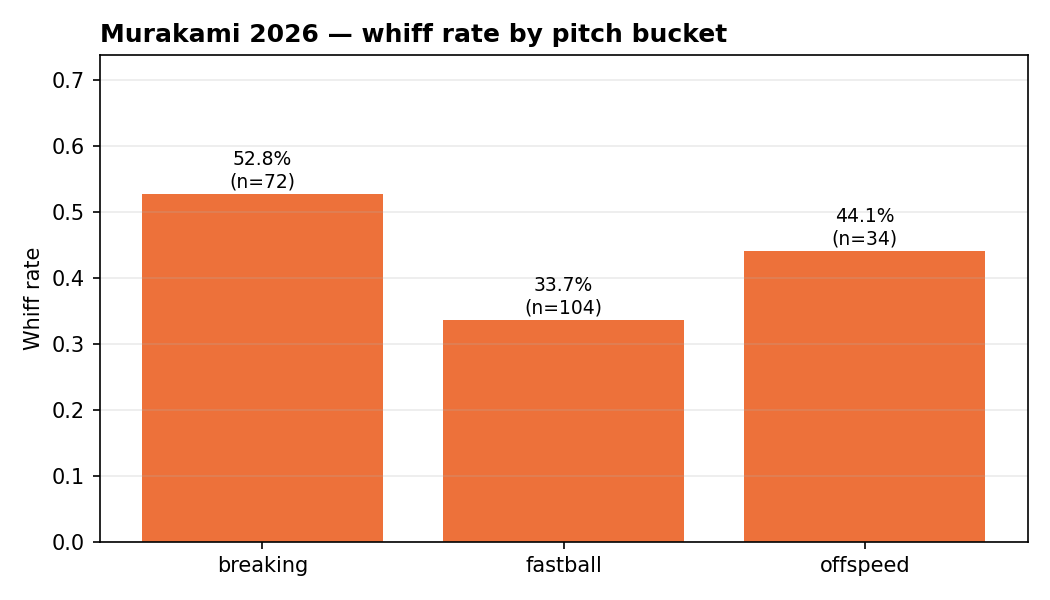
Plate-discipline change is, in the academic literature on hitter adjustment, the slowest of all skill changes to materialise. Power hitters in particular tend to improve their fastball production before they improve their breaking-ball recognition; Murakami is doing the former at a historic level and showing no signal so far of beginning the latter. The posterior, which would tighten meaningfully if the underlying rate were genuinely improving, has not.
Two paths
There are two ways the next two months can unfold. In the first, he learns. He chases fewer sliders below the zone, the whiff rate drifts into the high thirties, the contact quality holds, and he becomes a forty-home-run threat with strikeout problems — Ohtani's profile in 2018, except louder. In the second, he doesn't. The pitch mix continues to flip toward breaking balls, the fastball production becomes irrelevant because he stops getting fastballs, and the slugging line corrects sharply downward inside a fortnight.
The first scenario is what scouts have been quietly hoping for. The second is what the data, so far, suggests.
Tonight he will see fifteen breaking balls. He will probably whiff at eight of them. He will probably hit at least one ball a hundred and ten miles per hour. The slash line will move a tenth of a point in one direction or the other and our posteriors will tighten by a barely-visible margin. The evidence we are actually waiting for is the diet change — the moment in mid-May or early June when the fastball share settles below half and stays there, and we see whether a twenty-six-year-old with five years of NPB film and the loudest contact in baseball can do the one thing his career has never required him to do.
He will have to lay off. Or he will have to keep getting fastballs. So far, neither has happened.
Methodology: Bayesian beta-binomial on swing-and-miss rate with an NPB-informed Beta(51, 99) prior; bootstrap 80% confidence intervals on contact-quality means (10,000 resamples); posterior comparison of breaking-ball whiff rates uses independent Beta(1, 1) priors and 20,000 sampled draws. Data sourced from Statcast (Baseball Savant) via pybaseball. Analysis script and cached data are in the analysis/2026-05-murakami folder of the model repo. Series Focus pieces are written by hand and are not updated by the nightly cron.