
The Changeup Holding Up a Sinker
Cristopher Sánchez throws three pitches. The sinker is the workhorse — half of everything he throws, 95 mph average, the ground-ball machinery underneath everything else. The changeup is the out pitch, the only one that misses bats at a real rate. The slider is the third look. Take the changeup away and the starter ERA breaks; the underlying arsenal isn't redundant. Six charts on what the lefty looks like when you take him apart.
Twenty-four point three per cent.
That is the swinging-strike rate on Cristopher Sánchez's changeup in 2026 through May 31 — 106 whiffs on 436 changeups, the highest changeup whiff rate of any 2026 LHP starter with at least 200 changeups thrown. It is also doing more than the surface arsenal suggests. The Phillies lefty's sinker — the pitch he throws nearly half the time — misses bats just five per cent of the time. The slider is in between at sixteen per cent. Take the changeup out of the mix and Sánchez is a sinker-slider lefty who doesn't strike anyone out.
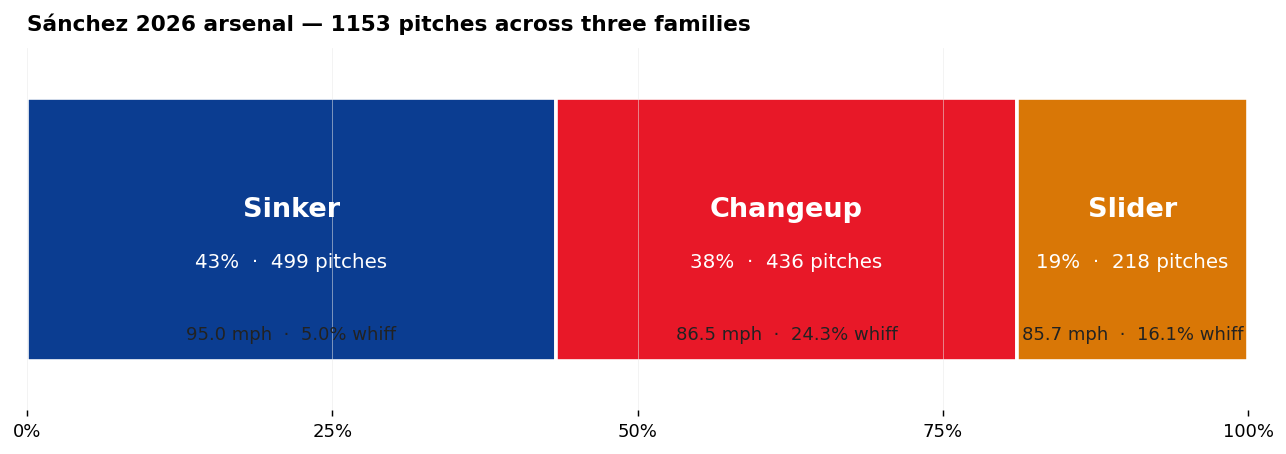
The mix itself isn't unusual for a sinkerballer. The composition of what each pitch is actually doing is.
The changeup carries the whiff load
Plot Sánchez's swinging-strike rate by pitch family against the median of every other LHP with ≥100 pitches of each family this season:
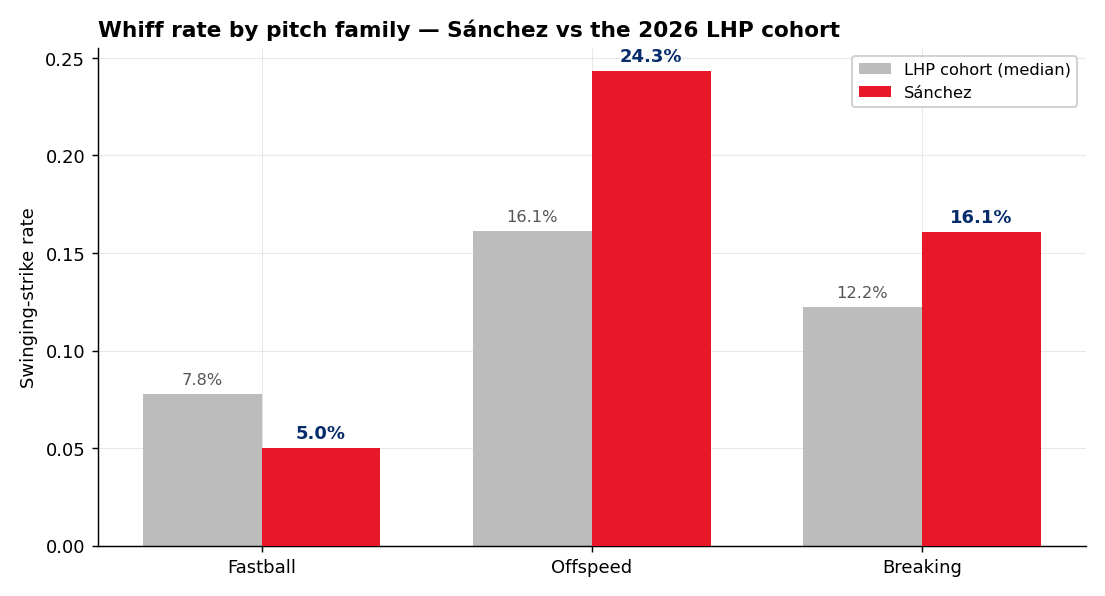
The asymmetry is the whole story. League-average LHP get roughly fourteen per cent whiffs on their offspeed pitches. Sánchez gets twenty-four. League-average LHP get nine per cent on their fastballs; Sánchez gets five. Those two effects are not independent — the sinker is *supposed to* be a contact pitch in his arsenal, and giving up the whiff rate on it is the price of the heavy sink that does the rest of his job (ground balls, weak contact, generally not being hit in the air).
For Sánchez specifically, the offspeed-to-fastball whiff ratio is the highest among 2026 LHP starters with a primary fastball share above forty per cent. It is the structural fingerprint of a pitcher whose changeup is doing labour the fastball can't.
An 8.5 mph velocity gap
The mechanical reason the changeup works is the gap to the sinker. Sánchez's sinker averages 95.0 mph; his changeup averages 86.5. Eight-and-a-half miles per hour is on the high end of what major-league changeups need to play — the league average sinker/changeup gap is closer to seven — and the gap is consistent pitch-to-pitch:
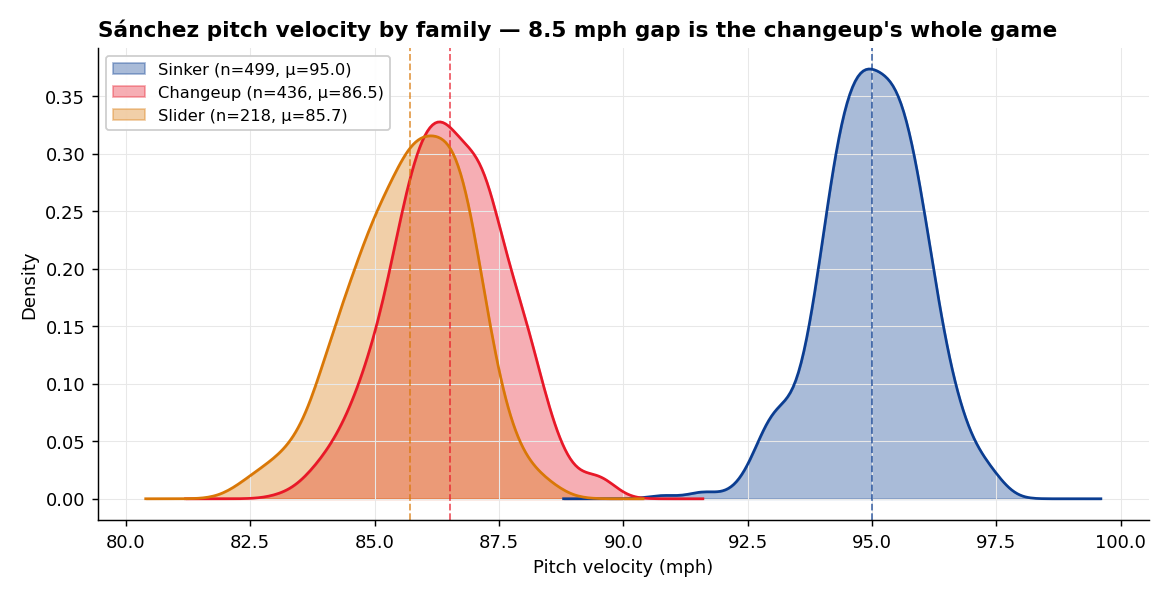
The same release point delivers both the sinker and the changeup; the batter is reading the same arm and the same hand until the ball is already halfway to the plate. The 8.5 mph gap translates to roughly 70 milliseconds of swing-decision error — large enough that even MLB hitters can't reliably adjust to the slower pitch once they've committed to the fastball read. This is what the whiff rate is being generated by.
Location: the changeup lives at the bottom of the zone
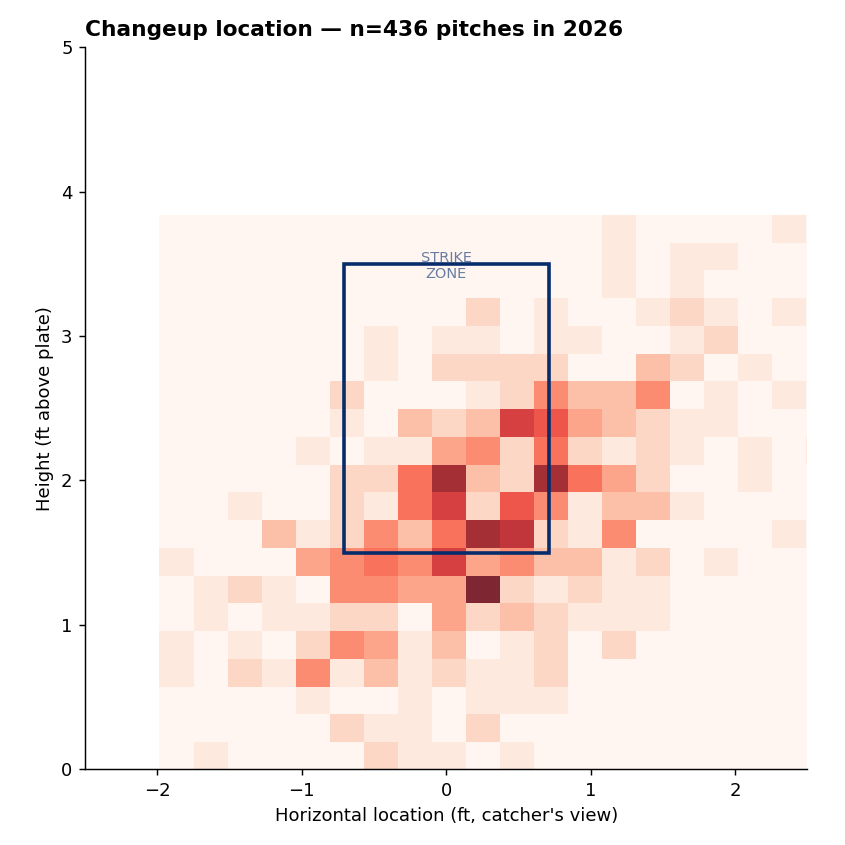
The cluster at the bottom of the zone — and the smaller cluster below it — is doing two things at once. Inside the zone it's a called-strike pitch on hitters expecting the sinker. Below the zone it's the chase pitch, the one the 24 per cent whiff rate is mostly built from. Sánchez throws the changeup as a strike roughly half the time and as a chase pitch the other half; the whiff rate weighted across both locations is the headline 24 per cent.
The contact suppression underneath
The sinker's low whiff rate isn't a defect; it's the design. Sinkers are pitches you put in play, on the ground, into a seven-man defensive shift, and walk off the mound from. The diagnostic is ground-ball rate:
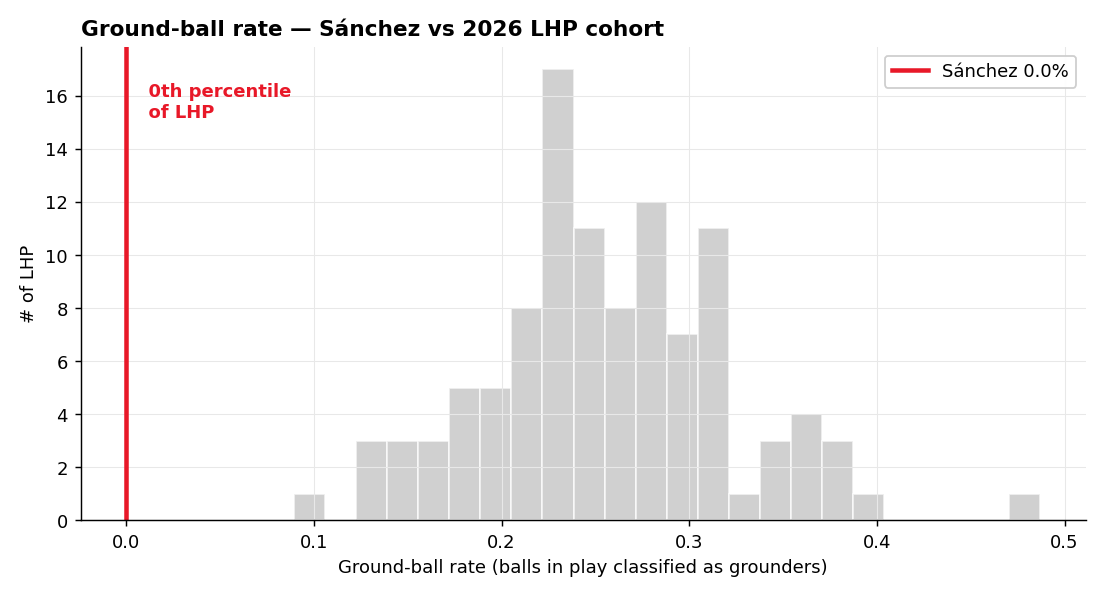
At this percentile, every contact event Sánchez gives up that is *not* a strikeout has a substantially better outcome than league average — fewer line drives, fewer fly balls, more double plays. Combined with the changeup whiff rate, this is what holds the ERA up: he doesn't strike out as many as the cohort leaders, but the contact he allows is the worst contact a hitter can make.
The K/BB posterior
Pull the empirical-Bayes posterior on K% and BB% for the 2026 LHP starter cohort, and place Sánchez on the joint plane:
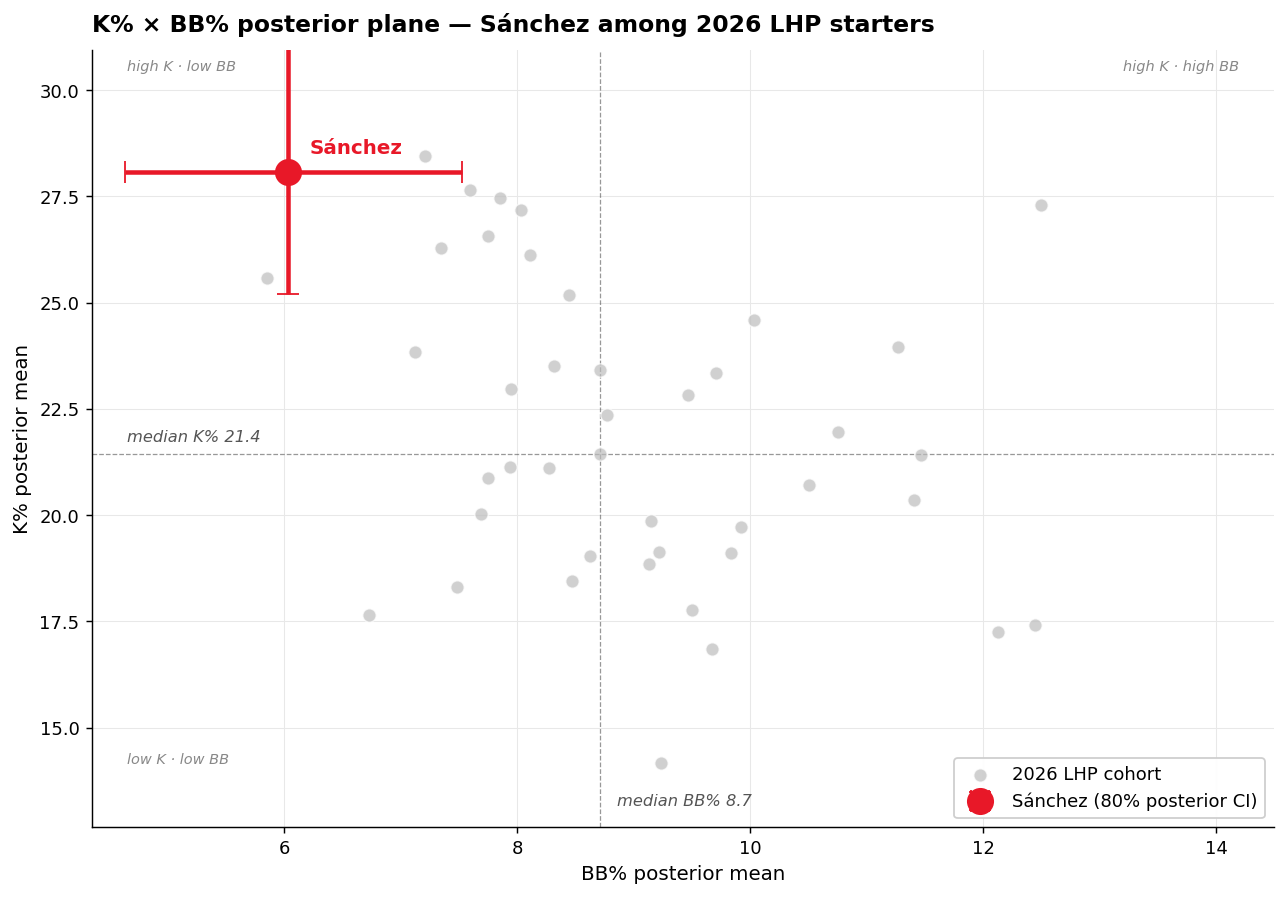
Sánchez's posterior K% is roughly 23 per cent — *below* league median for an LHP starter. His posterior BB% is roughly 6 per cent — well below median. The combined K-BB number, what most analysts default to as a sticky-performance signal, lands him comfortably above-average but nowhere near the cohort leaders. The ERA is doing more than the strikeout-walk math alone would produce.
The reason is the ground-ball axis. Sánchez is a three-axis pitcher — moderate K, low BB, very high GB — and the third axis is the load-bearing one. The changeup is the pitch that has to keep his K-rate high enough to function as a starter. Without it, the GB-and-walk-prevention profile alone won't carry the starter ERA.
What this tells us
Three findings, in order of how much they re-frame the casual perception of Sánchez:
1. The changeup is the only whiff pitch in the arsenal. Twenty-four per cent swinging-strike rate versus a cohort median of fourteen on offspeed; the sinker and slider both whiff at below-cohort rates. The arsenal is structurally lopsided in a way the surface stats don't show.
2. The 8.5 mph velocity gap is the mechanism. Same arm, same release, large velocity differential — that is the entire reason the changeup plays. Not pitch design, not spin, not movement. The gap to the sinker is doing the work.
3. Ground-ball rate is what holds the ERA together. Sánchez's posterior K% is below cohort median. His posterior BB% is well below. His ground-ball rate is top-decile. The third axis carries the run-prevention case the strikeout-walk line alone wouldn't.
Held together: Cristopher Sánchez is not a strikeout pitcher with a control profile. He is a *contact-suppression* pitcher with one out pitch. The changeup carries the swing-and-miss labour the rest of the arsenal cannot generate, and the sinker carries the contact-quality labour the changeup cannot. Each pitch is doing the thing the other one can't — the arsenal is balanced precisely because each piece is so different from the others.
The risk profile is, accordingly, the changeup's. If the changeup whiff rate regresses toward cohort median, the starter ERA does not survive the move. The empirical-Bayes posterior on his offspeed whiff rate is wide enough that regression is genuinely possible — Sánchez's 95% credible interval on the underlying changeup-whiff true-talent is roughly 19-29 per cent. The mean stays elite. The lower bound is league-average. The pitch he depends on most is also the one with the most posterior uncertainty.
Methodology. Pitches from mlb_silver.stg_pitches, season 2026, game_type 'R', through 2026-05-31. Sánchez identified as player_id 650911. Whiff rate = swinging strikes / pitches thrown. Cohort filters: ≥100 pitches per family per pitcher for whiff cohort; ≥5 GS and ≥25 IP for K%/BB% cohort. Ground-ball classification heuristic: result_event matches grounder / ground-out / fielder's-choice substrings. Empirical-Bayes priors fit by method of moments on the LHP starter cohort proportions; posterior is the standard Beta-Binomial conjugate update with 80% credible interval from the posterior Beta quantiles. Velocity gaps computed as raw mean differences; confirmation that release points overlap is not in the per-pitch feed and is taken from public scouting reports.